A guide for business leaders on aligning responsibility, control, and trust in data
In boardroom discussions, strategy papers and transformation programs, two data-related terms are repeated constantly: Data Governance and Data Quality. Both are critical — and yet, they’re often misunderstood, confused, or treated as interchangeable.
The truth? They serve different purposes — and both are essential for building a sustainable, data-driven organization.
Governance is the Framework. Quality is the Result.
Let’s break it down:
|
Concept |
What it focuses on |
Key Stakeholders |
Typical Questions It Answers |
|
Data Governance |
Rules, ownership, access, accountability, compliance |
CDO, Legal, IT, Audit |
Who owns this dataset? Who is allowed to change it? |
|
Data Quality |
Accuracy, completeness, consistency, reliability |
Business, Ops, Analysts |
Are the values correct? Can we use this data to make decisions? |
Think of governance as the operating manual, and quality as the check engine light.
Governance defines how data should be handled. Quality measures whether the data is usable.
Why Managing Only One Doesn’t Work
- Strong governance without quality = bureaucracy
You may know who owns a dataset, but if it’s 30% incomplete, it still can’t support decisions. - High-quality data without governance = chaos
If nobody knows who is responsible, how changes are approved, or where the data came from, you lose control — and trust. - Both together = trust at scale
Only when ownership, policies, and validation work together can you safely automate, scale, and innovate.
Why Business Teams Should Care
Too often, governance is seen as “an IT thing” and quality as “something analysts fix in Excel.”
But in reality:
- Poor quality leads to wasted marketing budgets, wrong pricing models, lost upselling potential
- Weak governance results in non-compliance, audit risk, delays in reporting
Ultimately, business performance suffers — and leadership notices it far too late.
How to Bring the Two Together
Here’s what mature organizations do:
- Define ownership and stewardship roles — not just at the dataset level, but down to business terms.
- Use shared platforms where governance rules and quality checks are enforced as part of the workflow.
- Automate validations and rule enforcement — not just once per year, but on every load, change or consumption.
- Track violations over time — because trust isn’t static.
- Include domain experts — let marketing define what a valid customer segment looks like, not just IT.
Where HEDDA.IO Fits In
While HEDDA.IO is a data quality solution, its design naturally aligns with governance goals:
- RuleBooks are version-controlled and auditable
- Execution results show who changed what, when
- Integrations with Excel, Databricks, and Fabric allow collaborative rule ownership
- Quality metrics can feed back into data catalogs and governance reports
In short: data quality with accountability — not just a checkbox, but a managed process.
Final Thought
Don’t think of data quality and governance as competing priorities.
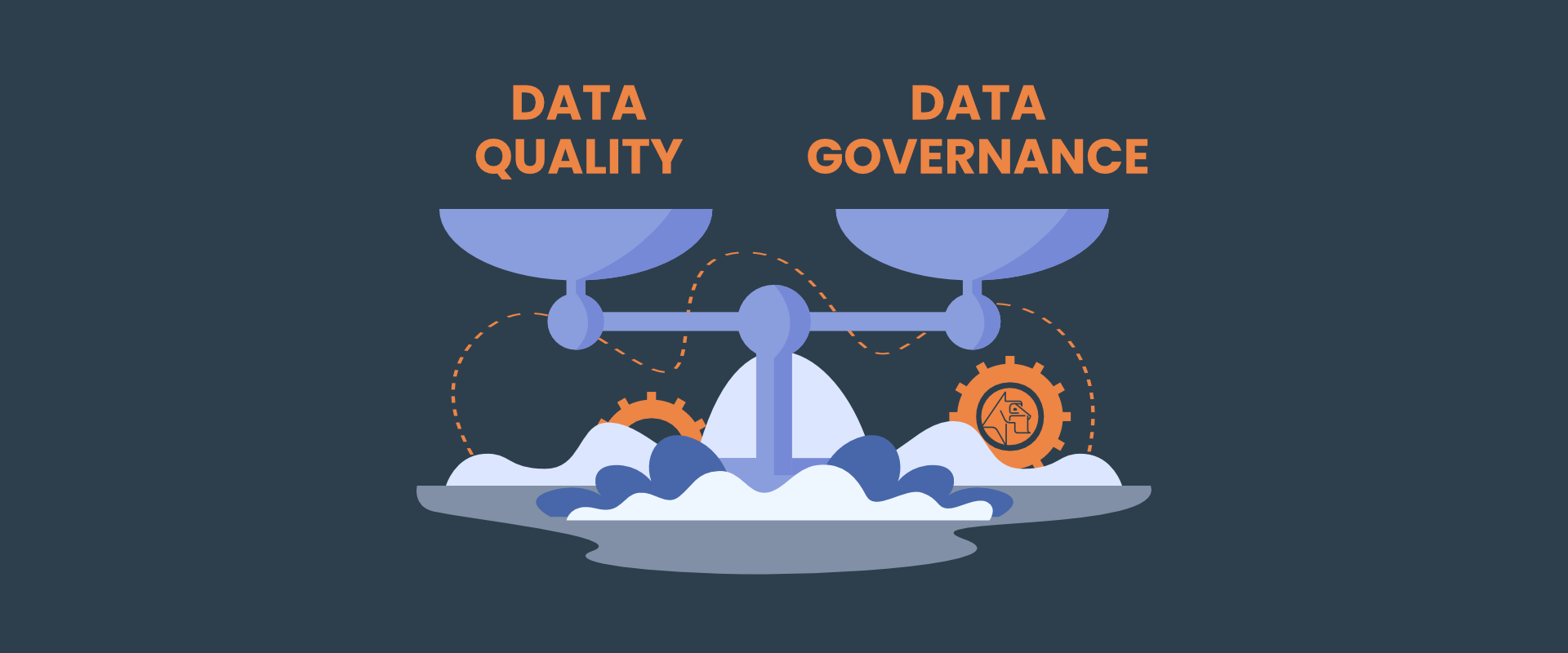
Think of them as two sides of the same coin — one provides control, the other provides confidence.
You wouldn’t fly with a pilot who has the checklist (governance) but no fuel readings (quality) — or vice versa.
In data, as in aviation, safety and direction depend on both.
Want to explore how your governance framework can be enriched with live quality metrics and business-owned rule validation? Let’s talk.